

Flight Data API Integration: 7 Things to Define Before You Start

Flight data API integration checklist: 7 things to define before you start

Most flight data API integration projects that run late don’t fail because of code.

Whether you are building a flight operations dashboard, an airport tool, an analytics product or an AI agent, these seven questions will help your product and data teams plan a flight data API integration that works from day one, and avoid paying for data you do not use.

1. The use case

Start with the decision the data will support, not with the API. “Show our fleet on a map”, “alert dispatch when a flight is delayed” and “analyze airport traffic over 12 months” need very different data.

Write one sentence per use case: who uses the data, for what decision, and how quickly they need to act. Everything else in this list follows from it.

2. The data fields

Flight data APIs can return 100+ fields per aircraft: position, altitude, speed, heading, call sign, registration, aircraft type, origin, destination, scheduled and actual times, and more.

List the fields each use case needs and mark them as must-have or nice-to-have. A shorter field list means smaller payloads, simpler code and, often, lower cost.

3. Geographic coverage

Define where you need data: one airport, a country, a region, oceanic routes or the whole world. Coverage varies by source. Ground ADS-B is strong over land, while satellite ADS-B and other sources fill gaps over oceans and remote areas.

Ask the provider for coverage in your specific areas, at the altitudes you care about. Low-altitude coverage near smaller airports can differ a lot from cruise-altitude coverage.

4. Update frequency

Update frequency is how often you receive a new position for each aircraft. A dashboard that refreshes every minute does not need the same rate as a system tracking aircraft on approach or on the ground.

Higher frequency gives smoother tracks and faster detection of changes. With a 2 Hz feed, for example, you get two position updates per second per aircraft. Match the rate to the use case: more data than you need adds cost and processing load. (Read more: What Does 2 Hz Flight Data Mean?)

5. Latency

Latency is the time between an aircraft broadcasting its position and that position reaching your system. It is different from update frequency: you can receive frequent updates that still arrive late.

For live operations, seconds matter. For reports and analytics, minutes or hours are usually fine. Ask providers for measured end-to-end latency, not just the refresh rate of their map.

6. Choose the Delivery Model for Your Flight Data API Integration

How the data reaches you shapes your architecture and your bill.

ModelHow it worksBest for
Streaming APIA continuous feed pushed to your systemLive operations, large volumes, many aircraft at once
On-demand APIYou query specific flights, airports or areas when neededApps, lookups, lower or irregular volumes
Historical dataPast flights delivered as files or by queryAnalytics, reporting, model training

Many teams combine them, for example, a stream for live tracking and historical data for monthly reports. Also confirm the formats (JSON, XML, CSV) your systems expect. (Read more: Real-Time vs. Historical Flight Data)

7. Scalability

A scalable flight data API integration grows with your product without forcing a rebuild.

Plan for where you will be in 12 to 24 months, not just at launch. Estimate how many aircraft, queries or regions you will need as the product grows.

Check how pricing scales with volume, what rate limits apply, and what support and service levels (SLAs) the provider offers when the integration becomes business-critical.

Your pre-integration checklist

  • ☐ One sentence per use case: who, what decision, how fast
  • ☐ Must-have and nice-to-have fields
  • ☐ Regions and altitudes you need covered
  • ☐ Required update frequency
  • ☐ Maximum acceptable latency
  • ☐ Delivery model and data format
  • ☐ Expected volume in 12 to 24 months, plus SLA needs

How AirNav can help

AirNav delivers flight data from 14+ sources and 55,000+ ADS-B receivers in 190+ countries, through a Stream API for high-volume live data, an On-Demand API for pay-per-query access, and historical data for analytics. Data comes in JSON, XML or CSV, with options up to 2 Hz.

Not sure which option fits your project? Talk to our team with your answers to the checklist above, and we will help you scope the right integration.
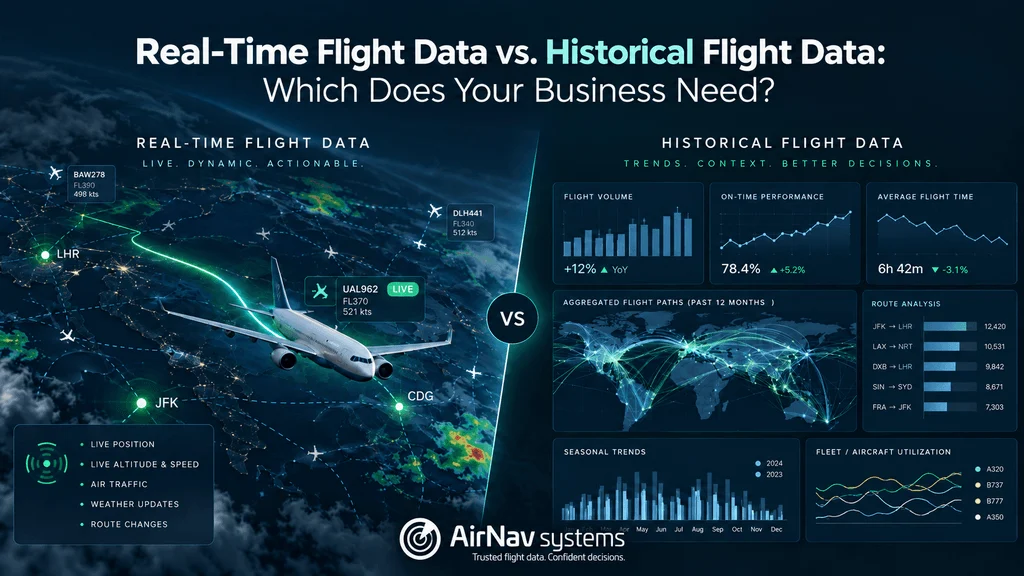
Real-Time Flight Data vs. Historical Flight Data: Which Does Your Business Need?

Real-time flight data vs historical flight data is an important distinction for aviation businesses choosing the right data solution. Real-time data provides continuously updated information for live operations and monitoring, while historical data allows organizations to analyze past flights, identify trends, generate reports and support long-term decision-making.

For some aviation teams, the priority is live operational visibility. For others, the value comes from analyzing past activity, identifying patterns or reviewing specific events. Many organizations need a combination of both real-time and historical data.

Understanding the difference helps buyers choose the right data source, delivery method and level of detail for the application they are building.

What is real-time flight data?

Real-time flight data provides continuously updated information about aircraft activity as flights are happening. It is used when a system, application or operational team needs current information about aircraft movements and changing flight situations.

Live data is time-sensitive. A position update, route change or operational event is useful because it reflects what is happening now rather than what happened hours or days ago.

  • live flight monitoring
  • fleet visibility
  • operational applications
  • aircraft tracking platforms
  • airport or airspace monitoring
  • alerts and event investigation
  • aviation software that depends on current flight activity

AirNav Systems provides live aviation data through its Stream API for organizations that need continuously updated flight information integrated into their own systems or applications.

What is historical flight data?

Historical flight data provides access to flight activity that has already occurred. Instead of answering what is happening now, it helps organizations examine what happened over a defined period.

This can mean reviewing an individual flight, analyzing activity at a particular airport, studying route patterns, or working with a larger historical dataset for research and analytics.

  • trend analysis
  • traffic pattern analysis
  • research
  • route analysis
  • operational reviews
  • aviation market analysis
  • model development
  • investigation of past events

For teams focused on analytics, research or long-term patterns, historical data may be more useful than a live stream because the business question is based on past activity rather than immediate operational awareness.

When does your business need real-time flight data?

Real-time data is most useful when the value of the information decreases as it gets older. If a user or system needs to react to current aircraft activity, live data is usually the starting point.

Airline and fleet operations

Operations teams may need current visibility into aircraft activity, routes and changing flight situations. In this environment, the value comes from maintaining an up-to-date operational picture rather than reviewing events after they happen.

Aviation software and data products

Developers building flight tracking, aviation intelligence or operational applications may require a continuous stream of flight information that can be integrated directly into their products.

Airport and airspace monitoring

Current flight activity can provide context around aircraft movements, traffic flows and activity in a defined airport or airspace environment.

Event monitoring and investigation

Live information can also help teams follow a developing situation and investigate what is happening while the event is still in progress.

When does your business need historical flight data?

Historical data becomes particularly useful when the objective is to identify patterns, compare periods or understand an event after it has taken place.

Research

Researchers can analyze aircraft trajectories, traffic patterns and aviation events across specific time periods. Historical datasets make it possible to compare activity and work with repeatable samples rather than relying only on a live view.

Traffic and route analysis

Historical data can help organizations study recurring patterns across routes, airports or regions. This can support broader analysis of aviation activity over time.

Business and aviation intelligence

Companies may use past flight activity to support market analysis, operational reviews or other forms of aviation intelligence where the relevant question is based on previous activity.

Reviewing specific events

When a team needs to understand what occurred during a particular flight or period, historical data lets them review that activity after the event.

When do you need both?

For many aviation applications, the answer is not real-time or historical data. It is both.

A platform might use live data to display current aircraft activity while using historical data to give users context around previous flights. An operations team may monitor activity in real time and later analyse historical data to understand recurring patterns. A technology company may use historical data during development and testing, then rely on a live stream when the application moves into production.

Using both allows an organization to connect what is happening now with what has happened before.

Other factors to consider when choosing flight data

The choice between real-time and historical data is important, but it is not the only factor that determines whether a flight data solution is suitable.

Update frequency

How frequently does your application need new information? Some use cases require greater temporal detail than others. AirNav Systems can provide flight data at up to 2 Hz, or about one update every 0.5 seconds.

Coverage

The geographic areas relevant to your application will influence the data solution you need. Consider coverage requirements alongside the type of data and delivery method.

Integration

Consider how the data will connect with your existing infrastructure, software or workflows. A live stream and a historical dataset can require very different technical approaches.

Data volume

The volume of information required can also affect the solution. A continuous live stream and a large historical dataset create different storage, processing and integration requirements.

Intended use

Operational monitoring, research, software development and long-term analysis all place different demands on flight data. Starting with the use case helps you avoid choosing a solution based only on the feed’s format or frequency.

Choosing the right AirNav flight data solution

AirNav Systems provides several ways to access aviation data depending on the application and business requirement.

Stream API: For systems and applications that require continuously updated flight data.

On Demand API: For applications that need flight information through request-based access.

Historical Flight Data: For organizations analyzing previous flight activity and aviation patterns.

Custom Data Solutions: For businesses with specific aviation data requirements that do not fit a standard delivery model.

The right option depends on what your organization needs to understand, how quickly the information is required and how the data will be used inside your product, operation or analysis workflow.

Real-time, historical or both?

If the question is “What is happening now?” — real-time data.

If the question is “What happened before?” — historical data.

If you need to connect the two — both.

Choosing the right flight data solution starts with understanding the business problem, not selecting a feed first. Once the use case is clear, it becomes easier to determine the appropriate data type, delivery method and level of detail.

Need help choosing the right flight data?

Tell us what you are building or analyzing, and our team can help identify the most appropriate AirNav Systems data solution.

Talk to AirNav Systems