
Real-Time Flight Data vs. Historical Flight Data: Which Does Your Business Need?

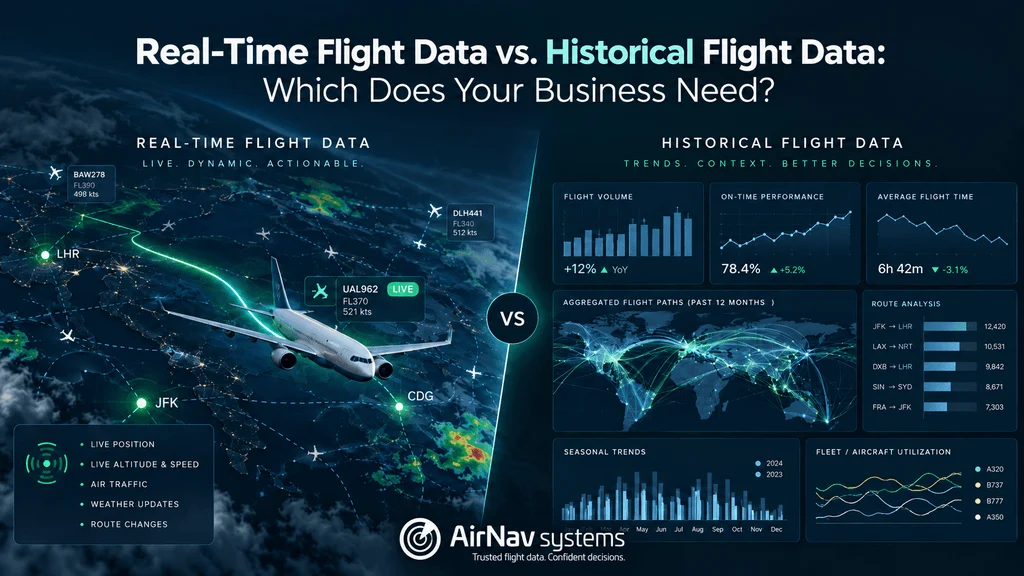
Real-time flight data vs historical flight data is an important distinction for aviation businesses choosing the right data solution. Real-time data provides continuously updated information for live operations and monitoring, while historical data allows organizations to analyze past flights, identify trends, generate reports and support long-term decision-making.

For some aviation teams, the priority is live operational visibility. For others, the value comes from analyzing past activity, identifying patterns or reviewing specific events. Many organizations need a combination of both real-time and historical data.

Understanding the difference helps buyers choose the right data source, delivery method and level of detail for the application they are building.

What is real-time flight data?

Real-time flight data provides continuously updated information about aircraft activity as flights are happening. It is used when a system, application or operational team needs current information about aircraft movements and changing flight situations.

Live data is time-sensitive. A position update, route change or operational event is useful because it reflects what is happening now rather than what happened hours or days ago.

  • live flight monitoring
  • fleet visibility
  • operational applications
  • aircraft tracking platforms
  • airport or airspace monitoring
  • alerts and event investigation
  • aviation software that depends on current flight activity

AirNav Systems provides live aviation data through its Stream API for organizations that need continuously updated flight information integrated into their own systems or applications.

What is historical flight data?

Historical flight data provides access to flight activity that has already occurred. Instead of answering what is happening now, it helps organizations examine what happened over a defined period.

This can mean reviewing an individual flight, analyzing activity at a particular airport, studying route patterns, or working with a larger historical dataset for research and analytics.

  • trend analysis
  • traffic pattern analysis
  • research
  • route analysis
  • operational reviews
  • aviation market analysis
  • model development
  • investigation of past events

For teams focused on analytics, research or long-term patterns, historical data may be more useful than a live stream because the business question is based on past activity rather than immediate operational awareness.

When does your business need real-time flight data?

Real-time data is most useful when the value of the information decreases as it gets older. If a user or system needs to react to current aircraft activity, live data is usually the starting point.

Airline and fleet operations

Operations teams may need current visibility into aircraft activity, routes and changing flight situations. In this environment, the value comes from maintaining an up-to-date operational picture rather than reviewing events after they happen.

Aviation software and data products

Developers building flight tracking, aviation intelligence or operational applications may require a continuous stream of flight information that can be integrated directly into their products.

Airport and airspace monitoring

Current flight activity can provide context around aircraft movements, traffic flows and activity in a defined airport or airspace environment.

Event monitoring and investigation

Live information can also help teams follow a developing situation and investigate what is happening while the event is still in progress.

When does your business need historical flight data?

Historical data becomes particularly useful when the objective is to identify patterns, compare periods or understand an event after it has taken place.

Research

Researchers can analyze aircraft trajectories, traffic patterns and aviation events across specific time periods. Historical datasets make it possible to compare activity and work with repeatable samples rather than relying only on a live view.

Traffic and route analysis

Historical data can help organizations study recurring patterns across routes, airports or regions. This can support broader analysis of aviation activity over time.

Business and aviation intelligence

Companies may use past flight activity to support market analysis, operational reviews or other forms of aviation intelligence where the relevant question is based on previous activity.

Reviewing specific events

When a team needs to understand what occurred during a particular flight or period, historical data lets them review that activity after the event.

When do you need both?

For many aviation applications, the answer is not real-time or historical data. It is both.

A platform might use live data to display current aircraft activity while using historical data to give users context around previous flights. An operations team may monitor activity in real time and later analyse historical data to understand recurring patterns. A technology company may use historical data during development and testing, then rely on a live stream when the application moves into production.

Using both allows an organization to connect what is happening now with what has happened before.

Other factors to consider when choosing flight data

The choice between real-time and historical data is important, but it is not the only factor that determines whether a flight data solution is suitable.

Update frequency

How frequently does your application need new information? Some use cases require greater temporal detail than others. AirNav Systems can provide flight data at up to 2 Hz, or about one update every 0.5 seconds.

Coverage

The geographic areas relevant to your application will influence the data solution you need. Consider coverage requirements alongside the type of data and delivery method.

Integration

Consider how the data will connect with your existing infrastructure, software or workflows. A live stream and a historical dataset can require very different technical approaches.

Data volume

The volume of information required can also affect the solution. A continuous live stream and a large historical dataset create different storage, processing and integration requirements.

Intended use

Operational monitoring, research, software development and long-term analysis all place different demands on flight data. Starting with the use case helps you avoid choosing a solution based only on the feed’s format or frequency.

Choosing the right AirNav flight data solution

AirNav Systems provides several ways to access aviation data depending on the application and business requirement.

Stream API: For systems and applications that require continuously updated flight data.

On Demand API: For applications that need flight information through request-based access.

Historical Flight Data: For organizations analyzing previous flight activity and aviation patterns.

Custom Data Solutions: For businesses with specific aviation data requirements that do not fit a standard delivery model.

The right option depends on what your organization needs to understand, how quickly the information is required and how the data will be used inside your product, operation or analysis workflow.

Real-time, historical or both?

If the question is “What is happening now?” — real-time data.

If the question is “What happened before?” — historical data.

If you need to connect the two — both.

Choosing the right flight data solution starts with understanding the business problem, not selecting a feed first. Once the use case is clear, it becomes easier to determine the appropriate data type, delivery method and level of detail.

Need help choosing the right flight data?

Tell us what you are building or analyzing, and our team can help identify the most appropriate AirNav Systems data solution.

Talk to AirNav Systems
What does 2 Hz Flight Data Mean and When Does Update Frequency Matter?

2 Hz flight data update frequency for real-time aircraft tracking

In aviation data, speed is not only about how quickly an aircraft is moving.

It is also about how frequently new information about that aircraft becomes available.

For some applications, receiving a new aircraft position every few seconds may be sufficient. For others, particularly those involving live monitoring, operational visibility or highly responsive digital products, more frequent flight data updates can make a meaningful difference.

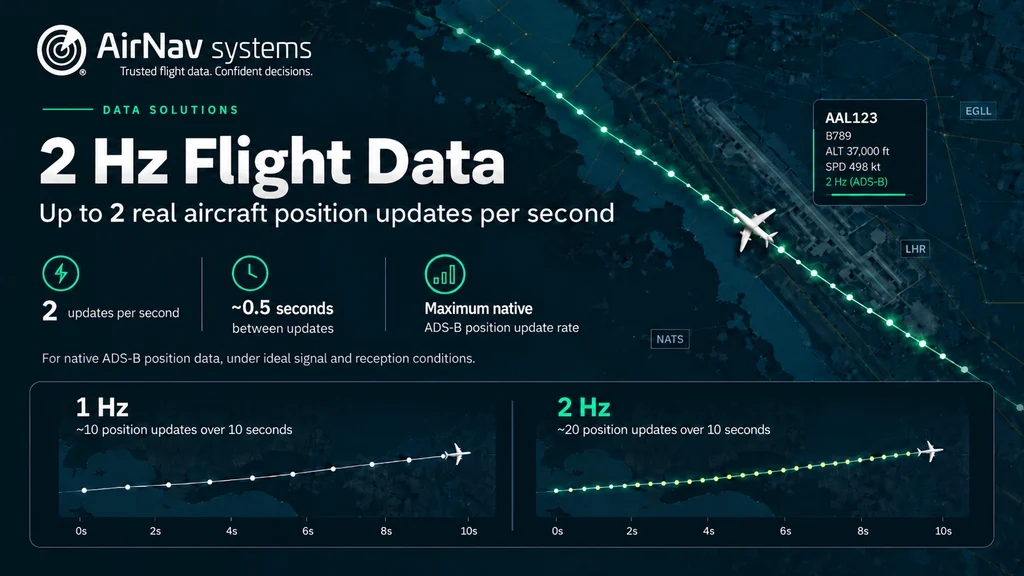
AirNav Systems can now support aircraft position data at 2 Hz, providing up to two position updates per second.

But what does that actually mean, and when does update frequency matter?

What does 2 Hz mean in flight data?

Hz, or hertz, describes how often something occurs per second.

In flight data, 2 Hz means aircraft position information can be updated up to twice per second.

This creates a much denser stream of position information compared with feeds that update less frequently.

Imagine following an aircraft along its route.

With fewer updates, the distance between each reported position may be greater. With more frequent updates, more data points represent the aircraft’s movement.

The result can be a smoother and more responsive picture of what is happening in the air.

Update frequency and latency are not the same thing

These two concepts are closely related, but you should not confuse them.

Update frequency describes how often new information becomes available.

Latency describes how long it takes that information to reach the system or user after it is generated.

A flight data feed can therefore provide frequent updates while still experiencing delivery delays.

For applications that depend on current aircraft information, both factors matter.

A high update frequency provides more data points. Low latency helps ensure those points arrive quickly enough to remain useful.

Together, they can support a much more responsive flight-tracking experience.

Why does flight data frequency matter?

Not every aviation application requires the highest possible update frequency.

The right frequency depends on how the data is used.

Historical analysis, for example, may not require aircraft positions to be updated several times per second.

A live operational interface can have very different requirements.

The important question is therefore not:

What is the highest flight data frequency available?

It is:

What update frequency does this particular application need?

Live flight-tracking platforms

For a flight-tracking platform, more frequent aircraft positions can help create smoother motion on the map.

Instead of an aircraft appearing to jump between widely separated positions, additional data points let the interface represent the flight’s progression more continuously.

This can improve the experience for users following individual flights as well as those exploring larger volumes of live air traffic.

Operational monitoring

Teams monitoring aircraft activity often need to understand how a situation is developing, not simply where an aircraft was several seconds ago.

More frequent updates can provide additional context around changing routes, altitude, speed and aircraft movement.

For airline, fleet and aviation operations teams, this can contribute to a more current operational picture.

The value is particularly relevant when multiple flights or changing situations need to be monitored simultaneously.

Airport activity

Aircraft movements around airports can change quickly.

Arrivals, departures, approaches, holding patterns and aircraft operating near an airport can all create a highly dynamic environment.

More frequent flight data can provide additional detail when monitoring these movements and help create a more responsive representation of airport activity.

Again, frequency is only one part of the picture. Coverage, data quality, latency and the availability of relevant flight information remain equally important.

Aviation applications and digital products

Aviation technology companies increasingly integrate flight data into their own products.

These may include:

  • customer-facing flight trackers
  • operational dashboards
  • alerting systems
  • analytics platforms
  • airport applications
  • aviation intelligence tools

For these organizations, update frequency can directly influence how the final product behaves.

A highly interactive application may benefit from more frequent data because users expect information to change smoothly and quickly.

A reporting tool may have completely different requirements.

This is why data frequency should be defined during the planning stage of any flight data integration.

Alerting and event monitoring

Some aviation applications monitor aircraft movement for specific events or changes.

In these situations, more frequent information can reduce the gap between individual position reports.

This may help systems identify developing movement patterns sooner or provide more detailed context around an event.

However, update frequency alone does not determine an alerting system’s effectiveness.

Reliable coverage, accurate timestamps, consistent data and appropriate processing remain essential.

More data is only useful if the data is reliable

A high-frequency feed is not automatically a high-quality flight data feed.

Receiving more aircraft positions is useful only if those positions are supported by reliable data infrastructure.

Companies evaluating flight data should therefore consider update frequency alongside several other factors:

Coverage
Does the provider deliver the required visibility in the regions where the application operates?

Source diversity
Does the data come from multiple sources rather than relying on a single collection method?

Latency
How quickly does the information reach the application?

Consistency
Are the outputs stable enough for the intended workflow?

Validation
How is raw aviation data processed and checked before delivery?

Scalability
Can the infrastructure support increasing volumes of aircraft, users or requests?

Update frequency is one part of a much larger data quality equation.

When is 2 Hz flight data useful?

2 Hz data can be particularly relevant when an application benefits from a highly current representation of aircraft movement.

Potential use cases include:

  • live flight tracking
  • operational monitoring
  • fleet visibility
  • airport applications
  • aviation software platforms
  • live analytics
  • event monitoring
  • interactive aircraft visualization

For other applications, a lower frequency may be entirely appropriate.

The objective should always be to match the data delivery model to the actual business requirement.

Choosing the right flight data frequency

Before integrating aviation data, organizations should define how the information will be used.

Questions worth asking include:

How quickly does the application need to react to changes?

How smooth does aircraft movement need to appear?

Is the data being used by people, automated systems or both?

How important is latency?

How many aircraft need to be monitored simultaneously?

Is the application focused on live operations or historical analysis?

Answering these questions makes it easier to determine whether higher frequency flight data provides meaningful value.

Flight data designed around the use case

No single flight data configuration fits every aviation business.

Some applications require detailed, highly frequent live data. Others need targeted API queries or large volumes of historical information.

AirNav Systems provides aviation data solutions tailored to different operational, analytical, and product requirements, including real-time data streams, On Demand APIs, Historical Flight Data, and Custom Data Solutions.

The important starting point is not simply how much data can be delivered.

It is understanding what the organization needs to achieve with it.

Need higher-frequency aviation data for your application or operational workflow?

Talk to the AirNav Systems team about your flight data requirements.