Pitch, Yaw and Roll: How We Turn Flight Data Into Realistic 3D Aircraft Movement
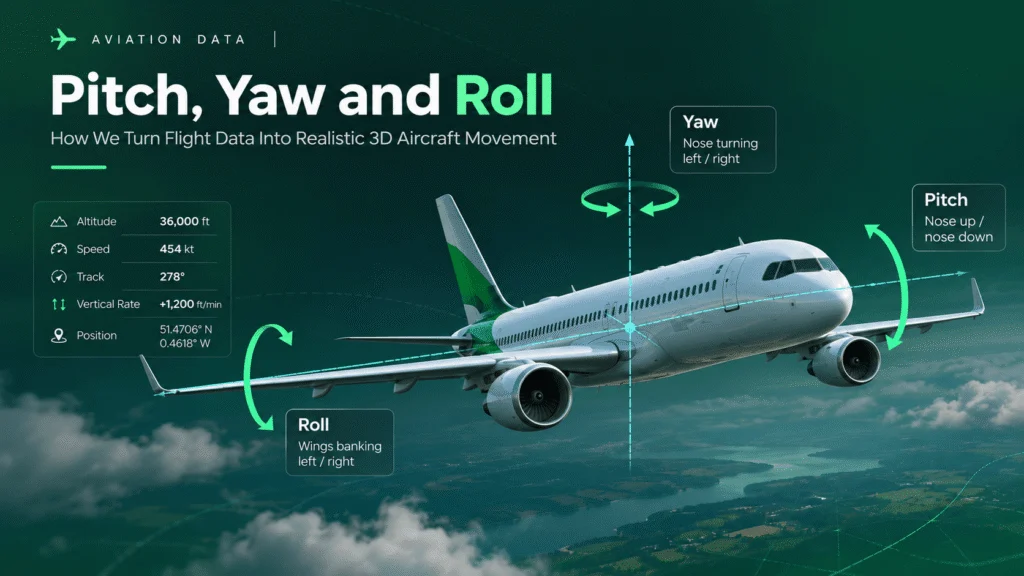
An aircraft rotates around three axes: pitch, roll and yaw. Pilots control them with every input, from the take-off rotation to a gentle bank on approach.
But here is something most people don’t know: ADS-B flight data doesn’t include pitch or roll at all. There is no value telling us that an aircraft is banked 15 degrees. So how does a 3D flight view show an aircraft climbing, turning, and levelling off in a way that looks real?
In this article, we explain what pitch, yaw and roll mean, what flight data can and can’t tell you, and how we turn simple data points into realistic 3D aircraft movement.
What are pitch, yaw and roll?
Pitch, yaw and roll are the three ways an aircraft rotates in the air. Each one happens around an imaginary line, or axis, that runs through the aircraft’s centre of gravity.
| Movement | What happens | Axis | Main control |
|---|---|---|---|
| Pitch | The nose moves up or down | Lateral axis (wingtip to wingtip) | Elevator, on the tail |
| Roll | One wing goes up and the other goes down | Longitudinal axis (nose to tail) | Ailerons, on the wings |
| Yaw | The nose turns left or right | Vertical axis (top to bottom) | Rudder, on the tail |
In normal flight, these movements work together. When an aircraft turns, it rolls into a bank, and the rudder keeps the turn smooth and coordinated. When it climbs, it pitches the nose up.
What flight data tells us about pitch, yaw and roll, and what it doesn’t
Flight tracking data comes mainly from ADS-B, the signal aircraft broadcast to share their position. AirNav collects it through more than 55,000 receivers in 190+ countries, combined with 14+ other data sources. (Read more about how ADS-B coverage works.)
For each aircraft, the data includes:
- Position (latitude and longitude)
- Altitude
- Ground speed (how fast the aircraft is moving over the ground)
- Track (the direction the aircraft is moving over the ground), and in some cases heading (the direction the nose is pointing)
- Vertical rate (how fast it is climbing or descending)
What ADS-B doesn’t include is the aircraft’s attitude. The data includes no pitch angle and no roll angle. We know where the aircraft is and where it is going, but not exactly how it is tilted.
Track and heading are not always the same, either. In a crosswind, the nose points slightly into the wind while the aircraft moves over the ground in a different direction. This difference is called the crab angle.
That’s where interpretation comes in. Some of these values give strong clues: vertical rate tells us whether the aircraft is climbing or descending, and a changing track tells us the aircraft is turning, which means it is banking. The more often the data updates, the better these clues become. (See what 2 Hz flight data means.)
How we turn flight data into realistic 3D movement
In our 3D view, every aircraft climbs, turns and levels off on screen. None of that movement comes from a pitch or roll value. It is calculated from the data we receive, combined with how aircraft actually fly.
Pitch comes from vertical rate, speed and phase of flight. Vertical rate tells us whether the aircraft is climbing or descending, which, combined with speed and phase of flight, lets us estimate a realistic pitch attitude. After take-off, an aircraft keeps its nose up until it reaches cruising altitude, so the model does the same. On a normal approach, an aircraft descends at around 700–800 ft/min with its nose slightly up, and the model shows that too.
Roll comes from changes in track. We watch the aircraft’s track in real time. When it starts to change, the aircraft is turning, so the model banks into the turn. The faster the track changes, the more it banks. When the track stops changing, the model levels its wings again.
The aircraft type sets the limits. Not every aircraft moves the same way. An airliner rarely banks more than about 30 degrees in normal flight, and it rolls into a turn gradually. A military fighter can bank much further and reach that angle much faster. The 3D model follows the limits of each aircraft type, so the movement stays believable.
Speed adds context. The same change in track means a different bank angle at different speeds. Speed helps us decide how sharp the turn really is.
The result is an aircraft that moves on screen the way it moves in the sky, built entirely from position, track, ground speed and vertical rate.
Why this matters for teams building with flight data
If you are building a 3D visualization, a training tool or a flight analysis product, this is the challenge you will face: the data tells you where an aircraft is, not how it is tilted.
The quality of what you can derive depends on the quality of the data underneath it. Frequent updates, accurate track and reliable vertical rate are what make a turn look like a turn and a climb look like a climb. (Read more on why not all flight data is created equal.)
The same data can also help teams spot sharp turns, steep climbs and unusual descents, without any attitude data at all.
Building something with aviation data? Explore AirNav’s flight data APIs and see what you can create.
FAQ
What is the difference between pitch, yaw and roll?
Pitch is the nose moving up or down, roll is the wings tilting left or right, and yaw is the nose turning left or right. Each is a rotation around a different axis of the aircraft.
Does ADS-B data include pitch and roll?
No. ADS-B data includes position, altitude, ground speed, track (and in some cases heading) and vertical rate, but not the aircraft’s pitch or roll angle.
How can a 3D flight view show an aircraft banking?
It calculates the bank from changes in track, ground speed and aircraft type. When the track changes, the aircraft is turning, so the model banks into the turn.
How far can an airliner bank?
In normal flight, airliners usually bank up to about 30 degrees. Military fighters can bank much further and much faster.